We are a global health company, focused on improving the health and vitality of those we serve. Through our two divisions, Cigna HealthcareSM and Evernorth Health Services®, we are committed to enhancing the lives of our clients, customers, and patients. In order to fulfill this goal, we continually challenge ourselves to strengthen and evolve our capabilities.
After-hours care: help your patients understand their options
November 10, 2026
When your patients have urgent medical needs outside your regular office hours, their first concern often isn’t just about what’s wrong, but also where they can get help. Clear after-hours guidance from your practice can help patients understand where to seek appropriate care and how to access timely support. This simple, proactive step can improve the patient experience, support continuity of care, and help patients make informed decisions when your office is closed.
Effective clinical communication is about more than setting boundaries — it also gives patients a safety net when you’re not available to care for them. Clear after-hours direction can help reduce the morning backlog of patient messages, prevent fragmented care, and strengthen patient trust.
The right care at the right time
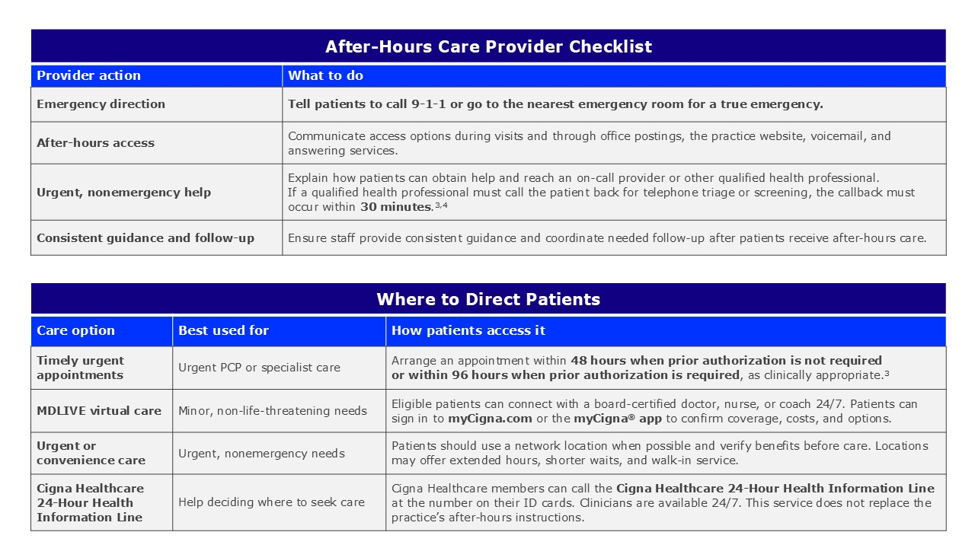
In a true emergency, it’s important that your patients dial 9-1-1 or go to the closest emergency room, and they should be informed of this in your practice’s after-hours voice message. For urgent situations that are not emergencies, patients may have access to other care options that can provide timely support. Some of these options are outlined below.
Virtual visits: MDLIVE®
Your patients with Cigna Healthcare® coverage can use their computer, tablet, or smartphone to visit with an MDLIVE board-certified doctor, nurse, or counselor for help with minor conditions that are not life-threatening, 24 hours a day, 365 days a year.1 Patients should confirm coverage, availability, and cost-sharing through their benefit plan before receiving services.
To access a live doctor, counselor, or nurse, your patients should:
Choose the type of care: urgent care, counseling, or preventive care.
Click Connect.
Urgent care centers and convenience care clinics
These facilities offer flexible and extended hours, shorter wait times, lower costs, and care without an appointment needed.
Urgent care centers: Your patients can receive care for urgent problems, such as sprains, cuts, fevers, and other health issues that are not true emergencies, and save hundreds of dollars when they choose this option over an emergency room.
Convenience care clinics: Your patients can receive care for routine health problems, such as earaches, sore throats, colds, and the flu, and obtain routine vaccines and immunizations. These clinics are typically less expensive than urgent care centers, and often conveniently located in a pharmacy or grocery store.
To find a participating urgent care center or convenience care clinic, your patients should:
From the drop-down menu, select the facility type (Urgent Care Facility or Convenience Care Clinics).
Proactively communicating after-hours care information
It’s important to proactively communicate your after-hours care recommendations to patients — such as during in-office visits, and via office postings, your website, answering machine, and your answering service — so that patients know their options if they ever need care outside of your normal office hours.
Your answering machine and answering service should inform patients:
To dial 9-1-1 in a true emergency, or to go to the closest emergency room.
Where to get immediate help if they are experiencing a mental health or substance use crisis, such as calling or texting the 988 Suicide & Crisis Lifeline, or dialing 9-1-1 or going to the closest emergency room if they are in immediate danger.
About other cost-effective options for urgent, non-emergency needs.
When to expect a call back from you if they leave a message on nights and weekends.
To contact you after receiving after-hours care so that you can assist them with their follow-up care needs.
Additional information
If your patients need live, one-on-one support and guidance about where to go for urgent or emergency care, they can call the Cigna Healthcare 24-Hour Health Information Line at the phone number on their Cigna Healthcare ID cards. Clinicians are available to help them 24 hours a day, 365 days a year. This service can help patients understand available care options but does not replace your practice’s after-hours instructions.
Resources for California HMO providers
California HMO providers can use the following guide to help members access appropriate care after regular office hours and understand when to use emergency, urgent, virtual, or clinical guidance services.2
1. MDLIVE services, availability, coverage, and cost-sharing vary by benefit plan and location.
2. Care-direction information is for general educational purposes and does not replace clinical judgement, medical advice, the practice’s after-hours instructions, or emergency services.